Caring for Your Soy Wax Candle: Ensuring Even Burning
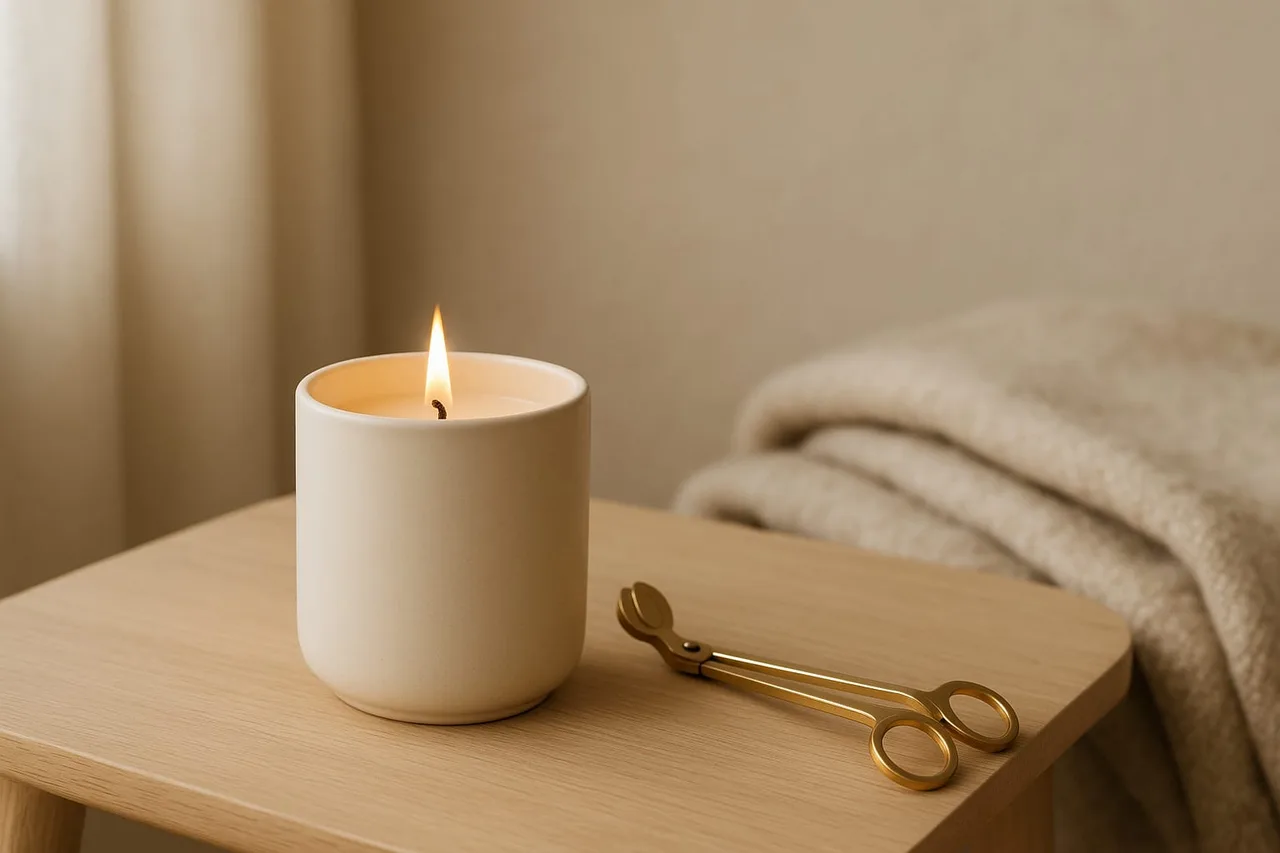
A soy wax scented candle lasts significantly longer if you allow it time to burn on its first use, trim the wick regularly, and protect it from drafts. Everything else follows from that: even melting, a steady fragrance in the room, and no soot on the glass rim. By adhering to these three points, you can often extend the burn time of a good candle by several hours.
Why Soy Wax Is Different from Paraffin
Plant-based soy wax has a lower melting point than paraffin. This means the wax liquefies at a lower temperature, releasing the fragrance more gently into the air. Instead of a sharp fragrance cloud in the first few moments, a calm, even fragrance carpet develops that lasts for the entire burn time.
This soft character has a downside: soy wax is more sensitive to handling mistakes. It does not forgive a too-short first burn phase, does not respond well to drafts, and displays any irregularity openly on the surface. That’s why developing a little routine, as described below, is worthwhile.
A slightly uneven, matte wax surface after cooling is not a defect. It is a typical characteristic of unrefined soy wax and says nothing about its quality. Crystalline structures and fine waves occur because the wax hardens at different speeds as it cools.
The First Lighting Matters Most
Soy wax has a memory. On the first burn, a melt pool forms, which the candle remembers for its entire life. If this pool is too small, the flame burns deeper into the same narrow channel in subsequent hours — the dreaded tunneling, where thick wax walls remain on the outside.
Thus, the rule is: Let it burn the first time until the entire wax surface has melted fully and the melt pool reaches the edge of the container. Depending on the diameter, this can take one to three hours. If you extinguish the candle after just twenty minutes, you waste a significant portion of the wax.
So plan your first lighting deliberately — on an evening when you plan to stay at home. A soy wax scented candle with warm amber and cedar notes reveals its depth only after the first half hour.
Trim the Wick: About Five Millimeters
Before each re-lighting, trim the wick to about five millimeters. This is the most crucial single step in candle care and takes just a few seconds. A nail scissors will suffice, but a wick trimmer works more cleanly as it catches the cut tip.
A wick that is too long leads to three problems: The flame becomes restless and flickers, wax consumption noticeably increases, and soot accumulates on the rim. If your scented candle is producing soot, in most cases, the wick is the cause — not the wax or the fragrance.
Also, remove burnt wick remnants and small black carbon particles from the solidified wax before lighting again. Otherwise, they will burn together, muddling both the flame and the fragrance.
Short wick, steady flame, clear fragrance — that’s how you recognize a well-cared-for candle at first glance.
Four Hours Is Enough
Although it’s tempting to let the candle burn all evening: Burning should be interrupted after at most four hours. After that, carbon residues increasingly accumulate on the wick, causing the flame to grow larger and more erratic, the wax to overheat, and the fragrance to lose its finesse.
Allow the candle to cool down, trim the wick, and light it again later. For extinguishing, a candle snuffer or wick dipper is better than blowing it out: It doesn’t create smoke and keeps the wick in position.
Drafts Are the Silent Enemy
An open window, a passage, a fan: Drafts divert the flame to the side. The wax then melts unevenly, pools inconsistently, and the usable burn time of the candle noticeably decreases. Place the candle on a stable, heat-resistant surface away from airflow — a side table, a sideboard, or a sturdy tray.
Also, avoid having textiles close by. A wool blanket belongs on the couch, not next to the flame.
Save Tunneling: The Hairdryer Method
If tunneling has already occurred with a wax ring left on the outside, the candle is not lost. Gently warm the surface with a hairdryer on medium setting until the wax at the edges becomes soft and smooths out. Keep the hairdryer moving and at a distance to avoid overheating the container in spots.
Once the surface is even again, allow the wax to cool completely and restart with a long burn phase — again, for as long as it takes until the melt pool reaches the edge. This method also works to cosmetically smooth out a slightly uneven surface, for instance, before the candle is given as a gift.
Store and Reuse
Between burn phases, soy wax appreciates a lid or a dark corner: Light and dust can compromise the fragrance oils. Stored cool and dry, a candle can maintain its aroma for up to one to two years without issue.
When only one or two centimeters of wax remain in the glass, it's time to stop — the base will become too hot. The leftover wax can be dissolved in hot water, and the glass cleaned with a bit of dish soap. Afterwards, it makes a lovely container for cotton pads, paperclips, or a small bouquet, next to a ceramic vase on the shelf.
Anyone who spends five minutes on candle care will hardly forget it. You can find more ideas for tranquil evenings and a harmonious home in the Living category.